Showing posts with label Oracle Community. Show all posts

Wednesday, 15 October 2025

Ideas as a precursor to Oracle APEX #JoelKallmanDay

 It seems if I post only once a year, it's for Joel Kallman Day...

Last year I hinted of a small side story to a remediation project that was upgrade the entire stack supporting a (mostly) Oracle Forms application.

Along the way I also had to remediate a little one-Form tool Connor McDonald build for developers, and it had some features of some note.

It should be stated this was written at a time when flip phones were all the rage - and notably before Oracle APEX gave birth to Interactive Reports.

I won't include a screenshot (for privacy concerns), but it's basically a multi-row data block allowing queries and edits of selected records - an Editable Grid, back in the heyday of Forms.

Hmm, let's see a list of default display options, plus the ability to save my own current filter - which stores the values set in Enter-Query mode - remember that?!

Saved Reports

And let's see an ability to re-order the columns, and or even hide specific columns.

Re-order columns

Yes, Connor created a customisable editable grid, in Oracle Forms, a few years before smartphones were a thing.

Editable Grid in APEX

All these highlighted features that come straight of the Oracle APEX box.

An example of great ideas that pre-date the technology that can better support them.

Or is it the ideas that drive the development of better technology?

Or perhaps a bit of both...


Wednesday, 16 October 2024

Upgrading Forms compared to APEX #JoelKallmanDay

My current project has involved rebuilding the entire aging stack for an environment that's currently 95% Forms, with any new work developed in Oracle APEX. The upgrade covers all layers -  from OS, to DB, to browser, and to application builders - all heading to contemporary versions.

The general directive is like-for-like, so the applications should work the way they used to, if not a little better.

So to dumb down the process, we basically need to recompile everything on the new stack, fix the gaps, then test extensively.

***

It's been an interesting project to compare the type of effort required to uplift a large Forms application compared with a modest set of Oracle APEX applications. I do this with the awareness that it's like comparing apples and toaster ovens, but the outcomes have been interesting enough (to me, at least), that it's forming the basis of my next presentation.

In fairness, there wasn't too much in regard to general syntax used within Forms that needed addressing. Nothing has significantly changed in Forms functionality, and we just needed the app to function as it did previously. 

There were a few environment level settings we found to help with some backwards compatibility, thereby saving some rewrite. 

From an infrastructure perspective, however, there were a number of aspects we needed to tackle to keep up with the modernisation of the stack. This included the launcher (Applet->FSAL), the SSO mechanism, document (blob) handling, and guiding the application to a tidy close after a timeout occurred. Compared to Oracle APEX in a modern ecosystem, the sting of that last item will linger.

***

This application has a considerable amount of blob content stored in (now deprecated) OrdImage data types, so that one item took up a considerable portion of effort - from shifting the data; to modifying the UI to load and view the attachments.

Oracle APEX came to the rescue for this case, replacing an old mod_plsql interface that supplemented a Form, and an ancient looking webutil UI in another.

The saddest part of the Forms upgrade was the amount of time I needed to spend ensuring session timeout didn't get the user stuck in a dead session. Part of me kept thinking how much of that 95% we could have started to shift to APEX with that time... 

***

As for the APEX applications, we took advantage of the testing that was going to happen and updated the Universal Theme (UT) of the applications.

Prompt to upgrade the APEX UT

I'm working through the issues that came out of this for the presentation, but most of the issues we needed to remediate were due to the UT update - not the upgrade of the database and the Oracle APEX version. And even then, most of the issues are relatively benign UI differences which don't need attention. A good handful of which were on purpose, for the benefit of APEX users - just against the fine grain of "like for like".

We could have upgraded both the database and the APEX version, left the UT alone, and only had a few minor version related adjustments to take care of - then still have a nice new bag of tricks to explore.

This is a far cry from earlier days of APEX where a big hurdle to upgrades was contemplating the significate cost of migrating to a newer theme with improved considerations.

But again, this wasn't necessary. I recall Joel presenting a session where he took an APEX application built some time ago, spanning a gap of multiple APEX versions. He just imported the application, and it ran without change - even when APEX was still a comparative youngster.

This methodology and mindset hasn't changed. I've done a few APEX upgrades in my time, and my recollection of any issues were related to heavy customisation - rarely native usage. Any native changes were always well documented, with a guide to transition to what is an improved outcome.

***

So today I share this heavily abbreviated and filtered anecdote of my recent explorations with Oracle technology, and once again remember Joel as a guiding force to help transform Oracle APEX into a development tool that has longevity without heavy maintenance, while still making the developer's life easier each release. 

And also a feature haven for those Forms developers out there.

I can even draft next year's post with another small side story from this upgrade project, reaching deeper into the past of Oracle APEX.

Wednesday, 11 October 2023

Pressing Pause on APEX #JoelKallmanDay

To honour this year's #JoelKallmanDay, I'd like to use this as an opportunity to speak about mental health, rather than get technical like I have done in the past.

Yes, my blog posts have been particularly lean - this is my first post since the same event in 2021 - I completely missed last year. Not just this special event, but from any posts whatsoever.

It's not that I've moved away from Oracle, nor that I'm short on inspiration - I'm still emailing myself ideas on a regular basis, but I haven't been setting time aside to transform them into something to post.

And I haven't been totally silent - I did update my Presentations page after presenting at a couple of local meetups this year. And you'll still find me on the Oracle and Stack Overflow forums.

There have been a few reasons for the slow-down in activity, but in part this has been due to my front-end development time being far less than it has been in the past. The Forms->APEX migration project I joined has been paused, and in the meantime I find myself on a project remediating the environment to first upgrade the stack from fax machines and teletype.... well, things aren't quite that old, but there's no point giving the car a flash new paint job without first replacing the tired old engine, right? 

But when you're into painting, mechanical work is far less exciting, and it can take a toll on how one feels about their job.

I still get to paint the odd fender, but that's only part-time.

Sunset after Eclipse 2023

It can't always be about rainbows and lollipops, but after many years of working in the candy factory at the end of a rainbow, I have to wait patiently for the new factory to open under a new rainbow.

Perhaps that's enough mixed-metaphors for now. I'm still here, still passionate about Oracle and the APEX product, and I have exciting times in my relatively near future.

It's also not the first time I've had setbacks of sorts. There have been significant development works that ended up being permanently parked. These were amazing builds that I had fun being involved with, but for one reason or another they either never ended up in the user's laps, or didn't stay there for long. However, besides feeling like my time was wasted, there wasn't really a direct impact on me.

Stepping away from the front-end and spending far more time in the back-end - or even finding myself updating some Oracle Forms and tweaking their configuration, really makes me appreciate what I've found in the highly productive world of Oracle APEX development.

In the meantime, I find community events like this, and perhaps also the first local conference in some time next month will invigorate me enough to take the time to revive my blogging vibe, and maybe a side project or two that haven't gone completely dormant.

To the reader: how have you handled lulls in your career? Have you found periods of time that, while perhaps still being technically interesting, haven't completely satiated the programmer's need to create? What did you do to quench your thirst?

Sunday, 7 November 2021

APEX in tense. #JoelKallmanDay

Now I feel extremely luck to live in a part of the world that has been relatively free of impact from COVID-19, certainly from a societal health perspective.

That said, I'm fairly certain there has been an indirect impact on my non-billable APEX activities - one only needs to look at my blog history over the past few years. Blogging is an outlet I've always enjoyed, and I miss doing regularly. 'Next week' I'll start doing it more regularly. Next week...

Blog frequency dips

But I was flicking through some tweets and saw Tim's announcement regarding #JoelKallmanDay, an initiative extending from past appreciation days, but now honouring the late great Joel Kallman, who sadly succumbed to COVID-19.

While I may be late to the event, I still feel compelled to contribute in some form. I only had the honour of meeting Joel a few times, but I know he's been an influence in my outreach. And I certainly feel his passion through the extended Oracle APEX team, whom I've also shared some wonderful moments with. I think about him frequently.

Like Tim, I thought I'd do an abridged history of my path to APEX. I had my first exposure to generating HTML from PL/SQL back in University, though too late in my final year project to do anything exciting with it - but I felt back then it seemed quite a powerful concept.

That said, I ended up cutting my programming teeth with Oracle Forms for a good number of years before my employer in ~2008 asked/directed/suggested I learn Oracle APEX while it was v3.2.

I was really given the opportunity at that point to jump in the deep end with APEX and explore what could really be done when it comes to designing applications that help the user get the job done. Not only that, I started the conferencing thing and got exposure to people like me from all over the world.

It wasn't long before I started training other people to use Oracle APEX, and if nothing else, that certainly helps you learn the ins, outs, and shortcomings of your development tool. Combined with regular involvment in the online forums, where even answering a question I thought I knew often comes with other people contributing their own perspectives, offering an enhanced method, or other consideration.

I've since had the chance to speak at two Kscopes, where I met Joel and quite a few people in the APEX team. They're all so passionate about the product, and offer their own special skills to help mature the product in the right direction - adding features faster than I can learn them. Not only that, they all know how to have fun outside the technology world. Something particularly important for our mental health in these challenging times.

I've now been on a few projects where we're transitioning Forms application to the web-based world that APEX lives, and now I have the pleasure of helping convert a large Forms application I had a decent part in developing - back before I knew what APEX was.

For me this is a particularly exciting time. It was somewhat of a plunge to leave my previous job during these testing times, but it's opened a raft of new opportunities - all the while I wish I had more time to tinker with my own little APEX side projects. 

Monday, 26 April 2021

Kicking the tyres on Oracle APEX 21.1

 It's lockdown on a long weekend, and Oracle APEX 21.1 has just been deployed to apex.oracle.com, how could I not have a play?

We've been provided a link to New Features, but for some aspects I'll need some help from the documentation, when it becomes available - and perhaps some examples from people more knowledgable than I.

Native Map

This will be one of those features where I'll need some more guidance, and I suspect this AskTom Office Hours session that I haven't watched yet would probably be a good start.

The create page wizard looks promising

Create native map

And after fiddling around with the region attributes, I was able to plot three lat/long addresses onto a map.

Native map runtime

I also noticed there were some native Dynamic Actions associated with the map region, but I'll patiently await further information on this one. 

Good to see it's dark-mode ready, though. 

Lazy Loading

This is one feature I've been waiting to become native, and I probably would have been a little disappointed if it didn't arrive with 21.1, and here it is, nice and simple.

Lazy loading option

We can emphasise the behaviour with the browser's device toolbar options, for instance, throttling to 'Low-end mobile'.

Here I have an IR and Classic Report both using the lazy loading option.

Lazy loading runtime

Custom built solutions can use the no-data-found message to inform the users data is still loading, I would like this feature to offer some facility in that regard.

Code Editor

I like it when we're giving options on what code editor features are available, and it looks like we've been provided a few more keys to the playground with the 'Monaco' based code editor.

Code editor settings

There are some APEX specific improvements, too. For instance, we're now notified when a page item doesn't exist - thought I think it needs a bit more polish. It appears to be case sensitive, and doesn't clean up very well once you've corrected the problem.

Code editor item reference check

It seems we have a few more keyboard shortcuts available now for case transformations. That's always nice.

Universal Theme enhancements

If you like the Redwood Light theme, it seems that's been given more love compared to the first round.

There are some added declarative options, but I'll probably need more context as to how they're used. I don't think the UT application has those guidelines yet, or I didn't see them.

Row CSS classes seems like it should have been there all along with Column CSS classes. What would be an example of it's use?

Grid layout property addition

CSS classes against the Theme Style seems like it will allow more elegance, but again, I'd like to see an example.

Theme style property addition

Having even a cursory look at these new features also made me consider how I've been utilising existing behaviours. The File URL for a theme style seems a better spot than I've been using for custom CSS I've added to fill gaps in the dark mode.

Template Options have always had a few surprises in version upgrades, though I'm not sure what the region Heading Level is supposed to do.

Region template options

Universal Theme application

I notice the UT app has some extra options in the navigation bar.

The version facility sounds like a fair addition for those who may be a version or so behind. I wonder what this changes, exactly. Does it affect content, or just the styling that's applied. Though I notice you can't select an older theme while dark mode style is applied.

UT app navbar

The Style option is pretty cool. I've been playing with a similar feature in my app, but it seems like I've been submitting the page like a chump - I'm curious as to how this work.

Date Picker

It's always good to get improvements on such a common component. The Maximum Item seems like a more declarative facility compared to what we have now, but now it appears to be dynamic - responding to a related item's selection. Perfect for from/to selections.

New date picker settings

Display Inline really stands out, must be for when date selection is rather important.

Now that DanielH is on the team, it almost seemed inevitable that the time picker would be enhanced in some form. This could mean another plugin is no longer required, though I'll reserve judgement until after I play some more.

Time picker enhancement

Import export as ZIP

This seemed inevitable, but I don't think it will impact me so much.

Application Data Loading

I need to spend time to revisit this feature. The column mapping aspect intrigues me.

Faceted Search enhancements.

I haven't used this facility in production yet, but it's good to see it progress as it's such a ubiquitous web feature.

REST Data sources

Schedule frequent loading of CSV data from the web? Getting data into the database easier has gotta be good.
Juergen has a good way of putting this:
"Put your Excel Sheet in your Sharepoint, change it as you like and I give you an real time App on top of it" feature

Markdown upgrades

This will float some people's boat.

Miscellaneous

I like the sound of client side numeric formatting, and improved client side validation.

Conclusion

This release seems in line with the stated roadmap, though as Andre describes, there are also some long standing painpoints that exist for the developer that could use some attention at some point.

The Oracle APEX development team have had some quality additions recently, though the whole COVID situation has potentially slowed some general improvements. 

That said, the product continues to improve, and the team responds well to community feedback. I also look forward to seeing improvements in the feedback application itself.

Get in there, kick the tyres, and give the development team some constructive feedback. We can all help make this an even better product.

Hold the phone! 

Just as I was about to clean the post up for submission, I saw Juergen's tweet about client side conditions on individual dynamic actions. I think the team are underselling that feature on the New Features list!

Client side condition in DA actions

Though as handy as this feature will be, I suspect it could be abused - in regard to maintainability. It could leave to code/behaviour that's a little difficult to follow. We'll have to keep an eye on that.


Thursday, 21 January 2021

2020 Blog Review

Ahem.

select apex_string.format(q'[It's been %s days since my last confession]' 
                         ,trunc(Sysdate) - date '2020-04-14'
) "G'day World" from dual
G'day World
-----------
It's been 282 days since my last confession

It's been so long, the Blogger UI has changed. I don't think I like it. Maybe another thing to consider adjusting in the new year...

It's also been four years since my last blog review, and I promised this one may be a doozy.

2020 was something else, right? I spent a good portion being thankful that I 

  1. kept my job
  2. could work from home
  3. live in such a remote city, which helped keep my family & friends safe

Aside from the APEX@Home event in April, I decided to scale my extra-curricular work right down, hence the lack of blog activity over the past year. I've kept active in the forums, because looking through those helps give my brain a bit of a reset when focus starts wandering.

But I wanted to be sure I had the time, energy, or whatever it was I needed to power through whatever 2020 potentially dished out.

Thankfully, from my end of the world, things are relatively OK. I've been to a few outdoor gigs, and aside from a few regular adjustments, life is kind of normal. Kind of. We're not completely insulated from the outside world, and things could change in a moment.However, I've used this down time to improve my investment game, should my IT career start to falter.

But that leads onto another astonishment for the year. I saw a lot of people I knew outside tech lose their jobs, though thankfully most of them had options elsewhere. Meanwhile, I'm presented with numerous avenues. I happened to choose a new avenue.

As of the end of January 2021, my tenure at Sage Computing Services comes to an end after 13 years. 

When I look back, it's staggering what I've done with the support of Penny at Sage.

  • Transitioned from Forms based development to Oracle APEX.
  • I published a video series using Oracle APEX. 
  • I published a book involving Oracle APEX. 
  • I was recognised as an Oracle ACE.
  • I spoke Kscope. Twice. Well, two cities, 5-6 sessions, I think.
  • Helped create some amazing project work with an amazing team.
  • Found a great work-life balance.

And I still have the yearn for more.  I have two more ideas for video series I still want to explore, and one could work as another book.  

It was a really tough choice leaving Sage, but yet again, Penny supported me through the options, and I'm fairly sure I've found a project that's the perfect fit for me, and it was hard to ignore.

And for a moment there I felt like I was presented with the cliche of red vs blue pill.

Development or ...

I'm not sure which one represents the world of development, but I didn't identify a managerial style job back at University - so while I 'manage' a lot of things as a developer, my passion is cutting code.

Therefore, the coming years are going to be explored as a contractor at a new firm, while I return to a past client to transition them from Forms to Oracle APEX. The good & bad news: I built a bunch of those Forms!

2020 project challenges were tough. I'd be kidding myself if I didn't think 2021 projects at a new location will be any different, but I'll be looking to step up my skills & habits while I'm at it.

Hopefully you'll be hearing more from me via this medium in 2021.
I've missed it, and I'm ready to come back.

And here's to seeing James Webb Space Telescope finally launch this year!

Tuesday, 14 April 2020

How to stay sane ... when things change.

From an e-mail I sent to colleagues, I thought I should also share it here (revised):

I'm known as the office optimist. And I do literally have many things to be grateful for. I still have a job, I’m able to work from home, and I have a decent study setup. And I’m an experienced introvert, this shelter-in-place business is no problem for me. I feel like one of the last people who’d go stir-crazy.

But recently I felt I had a crappy week. Worst in some time, and nothing really to do with current events. A vital piece of software kept flaking out on me, and I felt I didn’t achieve what I was aiming complete.

I opted out of an attempt at a virtual Friday Happy Hour for related reasons, even though I timing worked out that probably could have given it a go.

In hindsight I understand this is also in part due to a number of reasons I just made up for myself, to justify “not coming”, such as feeling like the audio will be awkward, or even just setting up the video/audio feed.

I’ve been listening to a few select podcast to keep up to speed with current events, Deep Background with Noah Feldman being one of them. But this particular episode from 27th March, "How to stay sane during a pandemic", seemed to have been a fly on my wall. I found it really hit the nail on the head, and I feel there’s messages in there that will speak to all of us, from a professor in happiness, no less.

Noah interviews Laurie Santos, from The Happiness Lab. Well worth the listen.
https://podcasts.apple.com/nz/podcast/how-to-stay-sane-during-a-pandemic/id1460055316?i=1000469702285

I hope you’re all doing ok.


Oracle APEX @ Home

The world has obviously lost a number of in-person conferences in recent times, but luckily we have people like Martin who asked the APEX community to jump, and they responded "how high?"

And out comes 24 hours of 24 speakers with APEX @ Home, on April 16th 2020. A lot of regular speakers appear to have pulled out some awesome sessions, and then there's my dinky one on APEX logic suggestions.


It's an AskTOM Office Hours session, so it's also recorded for later viewing, but you'll miss the chance for live Q&A.

And you'll also miss the challenge Connor put out there - to get a virtual selfie with all 24 speakers. Good luck with that.

What I've wanted to do, but haven't had the time, is roughly plot the time zone differences for each speaker. I'm talking at 8pm, but I bet it's all over the shop for every speaker, at various times of the day!

Wednesday, 15 January 2020

So you've submitted an abstract

You've thought hard about your conference talk ideas; you then fleshed out your idea and worked hard on an abstract; and finally you plucked up the courage to make the submission to that big conference.

What next?

Keep momentum.

#physics

It really depends on the style of your talk, but in most cases, just keep whatever momentum you have (or had back in December), and work on it in some form every week.

Wait, abstracts closed. Public voting complete. Aren't I just waiting for a March notification before I bother starting?

No.

There are a few reasons you could be working on your talks each week. For instance:
  1. Rome wasn't built in a day - it depends, but a reasonable talk should take at least 20 hours to develop, plus the time needed to gather the experience the talk represents, past, present, or future. Presentations left to the last minute can look & sound like it. Presentations started early will have time to cultivate, allow your ideas to progress as you write up progress so
  2. Experience - even if your talk isn't accepted, you have gained the experience necessary for a topic you've considered worthy enough to talk about it. Maybe you've already gained the experience, but compiling your thoughts will help you gain a deeper understanding of the topic.
    Maybe you gathered a few important insights along the way.
  3. Aim high - OK, maybe you end up getting a "sorry, not this time" email for the big conference. So what's happening locally? Do you have a regular meetup nearby? Is there another conference where this talk would fit well? Would the team at your current workplace benefit from listening to your talk for an hour? If you write it, people will come.
And as an extra tip 
  • Transform your speaker notes into search engine fodder
    I need to do this more often. I've seen more organised folk post their notes on GitHub, or as some sort of blog post. As a developer, sometimes I stumble across a great set of slides, but yearn for a little more context or content. It will always be useful for somebody, won't hurt your SEO, and you'll thank yourself immediately, and again in 6 months time when you google your own post.
How am I tackling my own submissions?

Slow at first, it's been a busy summer, but now I'm back at work building things, I feel like getting back into regular time aside.

I've submitted four ideas, to help my chances of being accepted. Maybe one idea is really good, but every other Tom, Dick, and Henrietta has submitted some variation of that idea. Perhaps your secondary submission fits rather well instead, among all the rest?

And given the thoughts above, I could make progress on all these ideas, knowing that they'll be useful somewhere along the line. Our local user group always seem happy to have me yak on about APEX.

Anyhoo, these were the titles for my Kscope20 submissions.
  • Oracle Reports to AOP Case Study
  • Visualising APEX Performance Monitoring
  • Navigating APEX Version Upgrades
  • A Practical Guide to APEX Authorisation Schemes
I was involved in the public voting exercise, and I not only saw some similar submissions, but a whole bunch of submissions on ideas I've considered, had, or wished that I had. Even if only a third of those submissions ever get produced, there's going to be some amazing content out there.

My titles are a little utilitarian, and lack some awesome word play I saw when reviewing abstracts, but I'm pretty excited about the building the content.

What am I doing to prepare these? I haven't got to this yet, have I?
  • AOP - I strategically chose this topic as I'm learning this as part of business as usual at work. My aim is to present a cheat-sheet style session to help new AOP developers hit the ground running. All I need to do is show up to work each day to prepare, though I need bed down the session structure.
  • APEX Performance monitoring - I've been writing charts & reports on these log tables for years, and I have the confidence I can piece together this presentation at will. I've offered different formats, so it may even be hands-on.
  • Version upgrades - I've done a few of these over time, and I've been making notes. I need to start playing on an empty canvas to help cultivate exactly how it will play out.
    And by this I mean probably both a simple text file that slowly fleshes out a list of key items I want to cover, and some sort of scratching/drawing the represents the story of my talk.
  • Authorisation Schemes - this one's been a real slow burn, something I've been wanting to do for a long time, but I hope to turn this into more than just a presentation. This is what I've been hinting about in this sites left menu bar, some form of publication.
    After piecing together a fairly clear breakdown of content, I may have procrastinated a little.
Regardless of where my experience is coming from to formulate the presentation, I typically start with a simple text file, flesh about my ideas, reorder as necessary, then start my slides.

Once the slides are done, I tend to go through them a few times, with a text file ready to note down simple modifications I want to make, without disrupting my flow too much.

Rinse and repeat, until your practice in front of a mirror/camera/friend comes out smooth, and on time.

Don't worry if you get nervous. We all get nervous.

PS - some of us have been living under metaphorical rocks, so if you've missed a bunch of posts by Martin Widlake on presenting, I recommend you check them out.

Tuesday, 26 November 2019

On the PL/SQL you don't write when using APEX.

Fancy joining in on a discussion with PL/SQL and Oracle APEX community members from around the world?

I'm honoured join Karen Cannell and Scott Spendolini, to be hosted by Steven Feuerstein in the next AskTom PL/SQL Office Hours on December 3, 2019.

It seems a few people haven't heard of these "office hours" sessions, but they're worth a go - more than just your average webinar. And they're all recorded for later viewing.

Topic
This is just the PL/SQL sessions! Every month they have one for Oracle APEX, SQL, Spatial, JavaScript, JSON, Database Security, and even more.

Product segments

It's probably one of the richest learning resources Oracle currently produces, and I really need to tap into more of it.

If the timezone gods allow it, I recommend live participation, as you really do get your questions answered. The produce managers handle the chatline, ensuring questions get followed through.

I think Steven's ensuring we have a good 15 minutes for questions, because they always come through. They keep the chat transcripts, too. The one for Oracle Forms Modernisation was all about the questions!

And it's free - you only need to sacrifice your email address, though it's probably the best email feed I have. Concise, infrequent, except my forum feed, of course.

On December 3, in my 15 minutes of fame, I plan to (spark debate?) about "the PL/SQL you don't need to write". I delivered this as an APEX application, instead of whipping out the ol' powerpoint.

Join in next week, and Karen will start with some decent habits, and the other Scott will no doubt enlighten us about security, or some such.

Free training - from Oracle... well, in this case, delegated to some passionate volunteers. ;p

Tuesday, 19 November 2019

So you want to submit a conference abstract?

It used to be our annual Perth conference that got me thinking about abstract ideas, but now it's the Kscope abstract submission deadlines that get my boat rocking.

But every day is a good day to think about the topics I'd like to might like to share with to your local community.

I've also been trying to convince a collegue to do their first presentation, and the questions in the ODTUG submission page got me thinking, so I thought I'd share some of those thoughts.

So here are some of the questions in the Kscope20 abstract submission form.


This is arguably the best conference for Oracle developers, and we only constitute a portion of delegates! I selected the APEX Track.

But the Session Title is obsiouly a good place to start. It needs to be catchy, concise, yet inform the reader as to what to expect - even without reading the abstract itself.
What session headline would grab you?
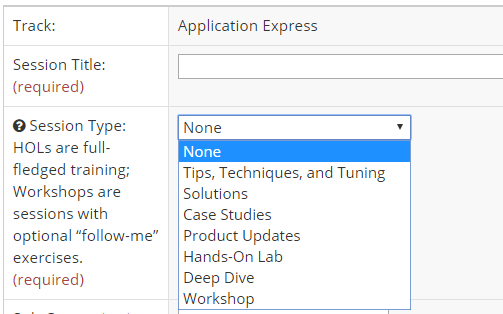
I like the descriptive distinction between HOLs and Workshops

The title can lead to focussing your content, which is necessary. Scope creep is something that's been on my back these last few years, and a good title can nail a good portion of this down. The Perth conference form asked for 3 objectives, which is an awesome way to focus scope. (I don't think this should be confused with Martin's concept of the evil threes)

Searching for my first presentation topic took some time. Something I felt experienced enough to talk about, something that felt relevant, useful to others. Now I have such a large list of ideas splattered on a Trello board, if anyone is thinking about doing their first presentation but can't think of a topic, I'm sure we can eke one out, even without necessarily knowing your skillset.

The Session Type can also be a prompt for ideas. Presentations can often be categorised by style and format, something Penny & I explored one year in a session of our own.

Maybe you have a collection of related tips, or you have a case-study to share where successfully utilised a nifty feature? Or some feature people haven't been talking about enough?

There is also a Sub-categorisation that varies by track, and helps align the content to relevant product sub-sets. There's an impressive amount of detail on these here.

Analytics / APEX / Database / Modern App Dev / ...

Naturally, at some point we need to write the abstract. The few paragraphs that inform the delegate about the story you're delivering. I've been stewing on mine for a while. Write a draft one night, review it another. What's being taught? Is it new? Is it compelling?

But the abstract is also helping define your scope. A simple aim, an interesting insight, and an awesome outcome.
What were your three main objectives? That's 10+10+10 minutes, with a few on each side - bang, you've got your talk. Now to divide & conquer. But remember, 10 minutes can disappear real fast.

Make sure there's no boasting or selling going on, that can be left for the notes for the review committee. I like this distinction. The Session Summary educates the delegates what you're talking about, the Notes educate the committee as to why you're gone with this topic, any maybe do some selling (of yourself) there. I also included my 3 session objectives, for a concise perspective.
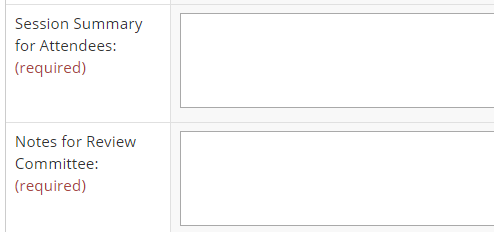
For everyone, then for the selection committee

And don't forget to check grammar and spelling!
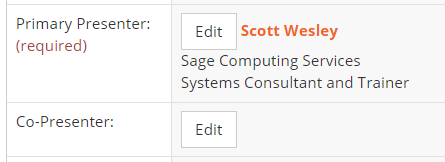
Who's on first? What's on second?
Clearly someone needs to be written as the primary presenter, but do you have a friend?

Seriously, you may have a colleague that contributed just as much to the topic, why not present with them? Well, there's probably a hoard of reasons, including the fact they may never have presented before - but if you're up for it, mentoring is rewarding for all parties. And starting to present can change your career trajectory.
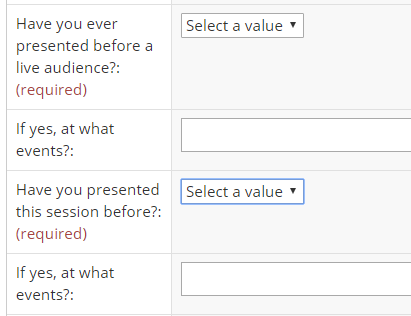
Is this good or bad?

This first question about having presented to a live audience before gives the reviewers some context regarding your experience, but this year, after just over a decade of presenting, I got a different perspective on the second question.

"Over a decade" sounds a little too grandiose. I pick one, sometimes two topics a year, and present them at our local conference. Sometimes I might do one twice, perhaps in a second city, or at a local meetup. I don't get much re-use.

However, some conference regulars will use & refine the same session numerous times a year. I had the opportunity to do my APEX for Forms Developers session 3 times, and it wasn't until the third that I really felt I nailed it. I had trimmed enough chaff, reordered the odd slide, integrated feedback, and neatened the story. And this is even with practice sessions under the belt, but Martin's recent post on controlling the presentation monster was a good kick in the behind for some aspects of my preparation that has been lacking in recent years. Perhaps I've become a little complacent.

As for the "Have you presented this session before" question, initially I thought it was a virtue to consider my presentation as 'fresh' for Kscope, something other people haven't had the opportunity to see yet. Perhaps I'd forgotten, because I certainly valued doing my inaugural Kscope session in Perth first.

(There is a 90 minute option)

Session Length is typically one hour. If this seems long, don't worry - it can be filled. And as it turns out, trimming a 60 minute presentation that was already a tad long into the Australian 45 minutes took a lot of cutting. But good cutting, like cutting superfluous code.

And it reminded me how good it is to get a targeted, concise presentation topic.

I realised my second abstract could also work as a 30 minute Workshop, so I added to the review committee notes, and maybe improved my chances a notch. My fourth submission could also work as a fully fledged hands on lab, so ... why not?

There are a heap of regular speakers at these gigs, but as Opal points out, there are a good percentage of new speakers every year - even at a high demand conference like Kscope. .

And it's not just Kscope - there are a wealth of conferences around the world, ready to listen to what you have to say. Check out the call for paper schedule at Clocwise (built with love using Oracle APEX).

There are a few other questions on the form, and plenty of other considerations when it comes to submitting abstracts, but these few stood out to be and I felt compelled to share.

I'd also add that there are so many quiet achievers out there that have expert knowledge of various features, they just don't blabber on blogs about it. We've got to find those pearls.

Also consider taking part in the public voting for Kscope abstracts. It's an interesting way to get a feel for what a good and bad abstract looks like, and may inspire a new range of ideas.

So bada bing bada boom, once you have your slides nearly done - practice practice practice, and have a listen to this sound advice from Connor - it's a great help <ahem>.
  • Honesty - I've heard this from Connor for years, it's so darn true.
  • Expert - we're all subject matter experts on something.
  • Love all the things - love the topic. love being there to share.
  • Practice - matters.
I was lucky enough to have as an instrumental guide on my path to speaking. I've heard these messages in various forms over the years, and he really hits the nail on the head.
And now he's being an instrumental advocate, providing various levels of support for Oracle developers around the world - not bad for just a tech guy.

Seriously though, he will help you out, and you won't feel like you need to write a 400 slide monster.

"Connor, your deck is 90 slides."

"Yeah"

"But you've only got 5 minutes"

"Yeah"

"..."

Tuesday, 12 November 2019

Things I learned at a user group event

Yesterday I attended a friendly, informative workshop by Shakeeb Rahman and Christina Cho, members of the Oracle APEX product team.

Reflecting on the worthiness of attending such an event, I thought I'd list out all the things I learned & observed.

  1. Everyone learns.
    It was observed that 'gurus' such as Trent, Lino, and myself were there, and maybe this might influence the level of detail content delivered. Sure, I like the details, and a particular pace, but I'm there to learn a bunch of things as much as the next person. My REST skills need a lot of work, it's always great to get a demonstration of features found in the new version. The APEX feature set has grown so much, I'm struggling to stay across it all. I attend these sessions because I know the value I can get out of them.
  2. Watching Shakeeb build.
    The last session involved Shakeeb using Quick SQL to build and populate data in seconds, then transforming the default output to look like a feed like Twitter. He did it in about 30 minutes, only using CSS once, maybe because his perfectionism was showing ;p
    As awesome as it was seeing the showcase that is APEX in action with declarative/low code techniques, I also get a lot out of seeing Shakeeb's thought processes, and how he moves about the IDE.
  3. REST Services.
    One of my attractions to this event was the workshop on REST services. I understand the mechanics, but have not had enough practice using the declarative features. Having a hands on lab where I not only receive instructions in person, but get to ask Christina deeper questions as I explore the workshop. This was invaluable to understanding the feature integration. I have a few posts in mind to help bake it in.
  4. Data is important.
    Our client would have appreciated Shakeeb's opening remarks. While we all know data is important, it can't be iterated enough to those decision makers that may not have enough understanding of the value of databases.
  5. APEX Longevity.
    I knew this one already, but I like the fact this slide has made it into Shakeeb's commentary. APEX has seen so many JavaScript frameworks come and go, with little resistance between versions. I think this is rarely seen in the programming world.
  6. Faceted search looks amazing.
    This will a boon for creating interactive applications that people are used to even quicker.
    I'm interested to see how this responds to more complicated queries, but there seems to be options for everything. I look forward to this feature, as we already build similar constructs already.
  7. The native Popup LOV looks even more suburb.
    They really have learnt from the two solid plugins that came before them. Based on the attributes I saw demonstrated, this has everything we need, and everything we didn't realise we should have. And this is iteration one. Awesome.
  8. I don't need to rely on a CSS overlay to remove toolips
  9. We can hide empty display positions in the layout editor
  10. The undo/redo tooltip was restored to native HTML in 19.x, different to the rest (thanks to sharing the love on Twitter).
  11. I was reminded of an auto-height template option for inline modals.
  12. There is a template option for 'icon and text' button templates to hide text for mobile devices.
  13. A component setting was introduced to transform application Switch items into the pill format - yet another application level optional upgrade between versions.
  14. Syntax in the code editor for SQL Workshop and Quick SQL is now highlighted. I think this improves readability and is a form of inline validation for your syntax.
  15. SQL Workshop Object Browser has a few more tables, including suggested sample queries for the tables - the same sort of group by queries that I use to help analyse what's going on in a table. The same queries that utilised in the faceted search analysis. Code & data re-use right there.
  16. We can now REST enable tables right from the SQL Workshop, with the flick of a switch.
  17. I was reminded Postman was a nifty tool for REST development.
  18. We can jump to the create application wizard from a table. I can't remember how, nor find the option, but I can't remember everything from the day... I make these notes to help, but hey.
  19. Data dictionary cache is a thing. Again, I can't recall exactly how it worked, but I've made a note to investigate later as I explore the faceted search facilities.
  20. The spotlight search has been expanded, and there are other nifty shortcuts that already exist. I use some already, but I now know to keep aware.
  21. Paged designer multi edit - I am looking forward to these improvements, which include the ability to change template options for multiple components at once - hallelujah! But I wasn't aware that some attributes were previously hidden during multi-edit mode, so this has eased.
  22. The ability to change the application logo has received all the declarative nick-knacks we needed.
  23. This application logo is separate from the one defined in the login screen, which as also received a wodge of declarative low code improvements.
  24. There is now a pre-built template style for dark mode. While I was aware of this, it's always beneficially for me to see Shakeeb operate the theme roller, since I don't use it enough.
  25. Theme roller facilities are more refined
  26. The Content Row report template - I'm looking forward to this so much I've retrofitted the template into 18.2, for demonstration
  27. All the interactive report dialogs have been re-written, with a fresh look.
  28. Menus UI can be tweaked with a 'callout' nature. We'll see how that's adopted in general...
  29. Inline regions have been given some upgrades. I've been playing with a page to experiment with these recently (post coming), so this event gave me the opportunity to ask some specific questions.
  30. Inline popups can be located near the invoking component, documented in the UT application.
  31. Lino showed me how to define inline region size with classes, instead of jQuery (to be included in post).
  32. Lino is approachable regarding my growing list of AOP questions.
  33. And as the session was beginning, I felt a little inspiration to solve a regular expression problem I was facing last week. Some interesting performance observations noted as I experimented further today, and had a regexp expert to review my work. (post coming)
  34. Christina is another solid member of the APEX family. I've had the pleasure of conversing with quite a few members of the team now, and they're a great bunch.
  35. Juniper berries are used to make gin - it was the drink'n'learn on the beer cap, in our afternoon wind-down.
And I reckon there might be a few I left off. The Q & A included some conjecture about 20.1.


Brisbane & Sydney also get the pleasure enlightment musings of Connor.

Not bad for a user group event, eh? 

It's a shame some people struggle to get support from their employers to attend such events, and more of a shame we don't see more students getting engaged. How do we reach them - the next generation?

I'm glad they came, and I'm glad I went. There are some growing APEX markets around here, and some with lulls. If we don't get the visits, the next round of students will not eventuate. It's not just the people who attend the workshops, but the flow on effect from those individuals who report back and share information with other team members. It's certainly what I did with my colleagues. Who knows who's ears could be listening in on that positive feedback.

Monday, 4 November 2019

Do you want to learn about database technology?

Do you live close enough to Melbourne, Brisbane, Sydney, Seoul, or Tokyo to attend a software development roadshow for a day in November?

Are you interested in how easy it is to build data driven web based applications?
Perhaps you're a student of the programming world?

Your local user group is hosting some visitors from the US that I think are worth listening & engaging with, in person. And if you're not a member of the user group, it's only $50 for the day.

https://blogs.oracle.com/apex/oracle-apex-apac-tour-2019

50 bucks.

For a day of learning, engagement, and networking with industry peers.

I can't emphasise that networking element enough, particularly for those still formulating their career goals & focus.

It's been a while since I was a graduate, but I relished the information I gathered at the local user group events. I was recently privvy to witnessing a member of the next generation of technology professional help shape her career at our conference.

It's worth investing a day in yourself, to help inspire your work tomorrow, to help nurture your love for your job. Whatever the stage of your career.

Warning, tangent ahead.
While I now find myself a regular speaker at such events, I also still value attending them, even with the advent of regular, engaging, recorded online technology seminars with experts and those that build the product.

That photo? That's Oracle product manager David Peake helping out. That's what these communities do - get you within one degree of separation of the product itself.

I can't keep up with all the new gadgets being made available in my development tool of choice.
I certainly need more practice with REST technology, and a hands-on-lab with the development team would really help.
We're also about to level up with our version, so another revision of all the new kit will be super handy.

And Shakeeb is a really slick presenter. It's not just the technology I learn about when watching the sessions by Shakeeb, or Connor & Steven, or many other seasoned (and some new) presenters.
And I'd like to meet Christina, add to the list of the APEX team I've met in person.

Seeing them in person is something else. Nothing beats having a face-to-face conversation with someone about ... anything really. And to then establish that rapport, that human-to-human contact with other people. It can remind us to be humble. A reminder that we all make mistakes; we all continue to learn; and most importantly - none of us know everything.

We see regular personalities on the speaking circuit, or those bloggers out there that pump out their experiences online. These are only a small percentage of all the developers out there, working hard, empowered by education, utilising online resources, leveraging off forum conversations. Sometimes it feels like they seem to know so many things about the product, but really, most of them are just making notes, and thankfully publishing them in a manner for us all to benefit. Don't let the imposter syndrome get you down.

And let's not forget the friendships that are forged at such events. Yes, you're allowed to have friendships at work, it helps keeps smiles on our faces when times are tough.

So. 50 bucks, unless you're already a member - then it's free!

Learn about how to get your FREE Oracle instance.
Learn how to use a low code development tool to build apps.
Learn how to source data from web services.
Learn what's in the latest version of the product.
Have an engaging session where you have the platform to ask anything.
And do it - if you have the chance to ask a burning question, odds are there is at least another person nearby with the same question.

Thank you, Oracle for your growing engagement with the community, and thank you to our local user groups for helping facilitate these visits, and most importantly, thank you to the community - actively producing content, and those who drive up the SEO by quietly read all the content.

Thursday, 10 October 2019

OGB Appreciation Day : Oracle Reports Server Queue Monitoring

Today is a day to celebrate what's great about our Oracle 'Groundbreakers' community. Our favourite stuff, what we're learning, horror stories, or just a little thanks.

I missed the second year because of holiday prep - so I decided to beat that this year by writing this the day I saw Tim's call-out on Twitter. Especially since I'm flying out to Melbourne for AUSOUG Connect, plus a little R&R.

I knew I had a few worthy ideas queued up, but I pondered for a moment on the most recent idea I noted.

So this year I'm going a little meta, or recursive, if you will - I'm acknowledging one of the posts from the original year. Oracle Reports Server Job Queue Monitoring. Thanks, Garth.

I wouldn't call this a duplicate post, rather a re-inforcement of this blog-fest, and I add some APEX spice.

I'm not entirely sure how I came across Garth's post, but I'm certain if it wasn't there, I wouldn't have realised I could transform that trusty but transient report queue servlet into table data in 3 easy steps.

A reliable page, but a little dated

And once they're in the database, we can APEX the shit out of it.

Now we can fold this data into awesomness

As Garth details in a second post, and Doc ID 2098657.1, it's a relatively simple matter of
  1. DCL to define table owner
  2. DDL to define some objects
  3. Minor Report Server configuration
Now we can query rw_server_queue to see how many of which reports were executed each day by who.

Why would we want to do this? It's 2019, why am I blogging about an Oracle Reports feature?
So we can analyse reports usage in the legacy system before migrating to AOP, of course!

You can also find the relevant SQL here, to make it easier for some of us to find & utilise.

So that's now two #ThanksOGB references in one, illustrating how worthy participation in such an even can be.

Past posts


2016 OTN - Dynamic Actions
2017 ODC - (dog at my homework)
2018 ODC - APEX Workspace Activity Logs
2019 OGB - Oracle Reports Server Queue Monitoring
2020 OGB - (quite possibly something that also shares a precursor to Oracle Reports)

Monday, 7 October 2019

So you want to learn Oracle APEX?

Are you involved with Oracle? Perhaps your a DBA, or a PL/SQL data master, possibly know a bit about Oracle Forms, and you want to learn what all the fuss is about regarding Oracle Application Express (APEX)?

My best elevator description? It's a low code development tool that lives in the browser. Yep, the IDE is a web page that allows you to add SQL, PL/SQL, modify a few attributes - and you've got a data driven web based application that runs on any device. Easy for any Oracle technologist to learn.

This is not a new tool, it's been around since 2004, conceptually even before then.
We've built applications that have lasted for years with minimal inteference. They've outlasted other popular frameworks, and they're still within touch of the present. Still doing the basics of the web, in a clever, interactive way.

AskTom has been using this technology before it was called HTML DB.

It's also being mentioned out there, in the world beyond our bubble.

And it's hitting the news for the right reasons - helping natural disasters.

And helping people take action regarding climate change.

This all started from Kscope19, and it appears momentum continues to grow.

So do you want to board this hardy vessel?
The community is strong & passionate.

Use this as your starting resource
http://apex.oracle.com/shortcuts

Sign up for a (no obligation) workspace on apex.oracle.com.

Your web page is your IDE now. Lucky, the modern browser is a nifty place to be.

That's APEX. You paste SQL queries / PL/SQL API calls in a box, change some attributes, and there you go. Simples. You have data driven web applications, ready to use on any device.

As for skillset, I have a few JavaScript one-liners I use regularly, sometimes I embed some simple HTML, and I have a mechanical understanding of CSS - which is just queries against your page content.
You know how a web page works? You know Oracle stuff (SQL, stored procedures)? You'll be fine.

If you have Oracle Forms experience, maybe check this out.

Empty the cup.

Try the documented tutorial
Install some packaged applications, check out how certain features tick.

Looking for your source code? It is just meta-data in some tables, check out
select * from apex_dictionary;
and
select * from apex_applications;
See how far the rabbit hole goes.
SQL developer has some dedicated tools for the job.

Try the Maze Runner presentation by Jorge & Jackie, to find your feet.
Want to know what components are available? go to apex.oracle.com/ut
Charts are particularly awesome: apex.oracle.com/charts
Got a question? Try the forums.
Like a conversation? Try Slack
Happy to chip in for some help? askMax.
Want a place to visit, learn & keep in touch for 5 minutes every day? Try apex.world
They have a page titled "How to start as a developer".
Also check out the plug-ins page, to fill any gaps in the builder.
Steady blog stream available here.
Do you like to listen? There are currently two active podcasts.
If you like books, I particularly recommend the collaborative efforts.
If you like videos, I have a series, and plan another. Caleb Curry also has our back.

Need to load spreadsheet data? This. And this.
Want to talk to web services? Find Carsten.
Do you really need to produce a PDF? AOP (APEX Office Print) is your best option.
Moet dingen vertalen? Translate APEX
Want to get a little funky with your page interactions? Check out Maxime's award winning demo app.
I recommend you learn not what you can do for Dynamic Actions, but what dynamic actions can do for you.

Want a second opinion on this list? Try this Github, because it adapts.

Want to get serious about delivering your app? Get a piece of an 'always free' tier, and check out Dimitri's guide. Or you could build you own stack with the free Oracle XE.

Note, the preferred pronounciation is a-pex, not app-ex. I blame my accent for any mispronounciations ;p This guy knows.

It's also "APEX", not "Apex". Possibly as not to be confused with SaleForce 'Apex', which if I recall is something pretending to be Java. "ApEx" is as painful as camelCase.

You generally need to prefix any searches with "oracle apex"

Or just ask a question on Twitter with the hashtag #orclapex. Someone is bound to point you in the right direction.

Note that even those without a Twitter account can browser activity in this tag. I recommend getting involved, it's an active zone for the Oracle team.
You might see it as #orclAPEX, which not only helps get it right, but helps #a11y

Let me know if you think something else belongs here.

#letswreckthistogether