Showing posts with label Public Speaking. Show all posts

Wednesday, 15 January 2020

So you've submitted an abstract

You've thought hard about your conference talk ideas; you then fleshed out your idea and worked hard on an abstract; and finally you plucked up the courage to make the submission to that big conference.

What next?

Keep momentum.

#physics

It really depends on the style of your talk, but in most cases, just keep whatever momentum you have (or had back in December), and work on it in some form every week.

Wait, abstracts closed. Public voting complete. Aren't I just waiting for a March notification before I bother starting?

No.

There are a few reasons you could be working on your talks each week. For instance:
  1. Rome wasn't built in a day - it depends, but a reasonable talk should take at least 20 hours to develop, plus the time needed to gather the experience the talk represents, past, present, or future. Presentations left to the last minute can look & sound like it. Presentations started early will have time to cultivate, allow your ideas to progress as you write up progress so
  2. Experience - even if your talk isn't accepted, you have gained the experience necessary for a topic you've considered worthy enough to talk about it. Maybe you've already gained the experience, but compiling your thoughts will help you gain a deeper understanding of the topic.
    Maybe you gathered a few important insights along the way.
  3. Aim high - OK, maybe you end up getting a "sorry, not this time" email for the big conference. So what's happening locally? Do you have a regular meetup nearby? Is there another conference where this talk would fit well? Would the team at your current workplace benefit from listening to your talk for an hour? If you write it, people will come.
And as an extra tip 
  • Transform your speaker notes into search engine fodder
    I need to do this more often. I've seen more organised folk post their notes on GitHub, or as some sort of blog post. As a developer, sometimes I stumble across a great set of slides, but yearn for a little more context or content. It will always be useful for somebody, won't hurt your SEO, and you'll thank yourself immediately, and again in 6 months time when you google your own post.
How am I tackling my own submissions?

Slow at first, it's been a busy summer, but now I'm back at work building things, I feel like getting back into regular time aside.

I've submitted four ideas, to help my chances of being accepted. Maybe one idea is really good, but every other Tom, Dick, and Henrietta has submitted some variation of that idea. Perhaps your secondary submission fits rather well instead, among all the rest?

And given the thoughts above, I could make progress on all these ideas, knowing that they'll be useful somewhere along the line. Our local user group always seem happy to have me yak on about APEX.

Anyhoo, these were the titles for my Kscope20 submissions.
  • Oracle Reports to AOP Case Study
  • Visualising APEX Performance Monitoring
  • Navigating APEX Version Upgrades
  • A Practical Guide to APEX Authorisation Schemes
I was involved in the public voting exercise, and I not only saw some similar submissions, but a whole bunch of submissions on ideas I've considered, had, or wished that I had. Even if only a third of those submissions ever get produced, there's going to be some amazing content out there.

My titles are a little utilitarian, and lack some awesome word play I saw when reviewing abstracts, but I'm pretty excited about the building the content.

What am I doing to prepare these? I haven't got to this yet, have I?
  • AOP - I strategically chose this topic as I'm learning this as part of business as usual at work. My aim is to present a cheat-sheet style session to help new AOP developers hit the ground running. All I need to do is show up to work each day to prepare, though I need bed down the session structure.
  • APEX Performance monitoring - I've been writing charts & reports on these log tables for years, and I have the confidence I can piece together this presentation at will. I've offered different formats, so it may even be hands-on.
  • Version upgrades - I've done a few of these over time, and I've been making notes. I need to start playing on an empty canvas to help cultivate exactly how it will play out.
    And by this I mean probably both a simple text file that slowly fleshes out a list of key items I want to cover, and some sort of scratching/drawing the represents the story of my talk.
  • Authorisation Schemes - this one's been a real slow burn, something I've been wanting to do for a long time, but I hope to turn this into more than just a presentation. This is what I've been hinting about in this sites left menu bar, some form of publication.
    After piecing together a fairly clear breakdown of content, I may have procrastinated a little.
Regardless of where my experience is coming from to formulate the presentation, I typically start with a simple text file, flesh about my ideas, reorder as necessary, then start my slides.

Once the slides are done, I tend to go through them a few times, with a text file ready to note down simple modifications I want to make, without disrupting my flow too much.

Rinse and repeat, until your practice in front of a mirror/camera/friend comes out smooth, and on time.

Don't worry if you get nervous. We all get nervous.

PS - some of us have been living under metaphorical rocks, so if you've missed a bunch of posts by Martin Widlake on presenting, I recommend you check them out.

Tuesday, 19 November 2019

So you want to submit a conference abstract?

It used to be our annual Perth conference that got me thinking about abstract ideas, but now it's the Kscope abstract submission deadlines that get my boat rocking.

But every day is a good day to think about the topics I'd like to might like to share with to your local community.

I've also been trying to convince a collegue to do their first presentation, and the questions in the ODTUG submission page got me thinking, so I thought I'd share some of those thoughts.

So here are some of the questions in the Kscope20 abstract submission form.


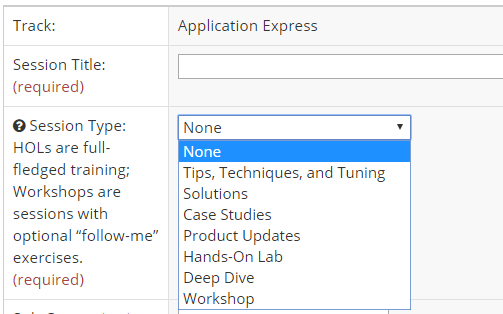
This is arguably the best conference for Oracle developers, and we only constitute a portion of delegates! I selected the APEX Track.

But the Session Title is obsiouly a good place to start. It needs to be catchy, concise, yet inform the reader as to what to expect - even without reading the abstract itself.
What session headline would grab you?

I like the descriptive distinction between HOLs and Workshops

The title can lead to focussing your content, which is necessary. Scope creep is something that's been on my back these last few years, and a good title can nail a good portion of this down. The Perth conference form asked for 3 objectives, which is an awesome way to focus scope. (I don't think this should be confused with Martin's concept of the evil threes)

Searching for my first presentation topic took some time. Something I felt experienced enough to talk about, something that felt relevant, useful to others. Now I have such a large list of ideas splattered on a Trello board, if anyone is thinking about doing their first presentation but can't think of a topic, I'm sure we can eke one out, even without necessarily knowing your skillset.

The Session Type can also be a prompt for ideas. Presentations can often be categorised by style and format, something Penny & I explored one year in a session of our own.

Maybe you have a collection of related tips, or you have a case-study to share where successfully utilised a nifty feature? Or some feature people haven't been talking about enough?

There is also a Sub-categorisation that varies by track, and helps align the content to relevant product sub-sets. There's an impressive amount of detail on these here.

Analytics / APEX / Database / Modern App Dev / ...

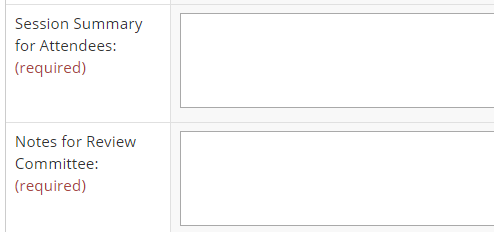
Naturally, at some point we need to write the abstract. The few paragraphs that inform the delegate about the story you're delivering. I've been stewing on mine for a while. Write a draft one night, review it another. What's being taught? Is it new? Is it compelling?

But the abstract is also helping define your scope. A simple aim, an interesting insight, and an awesome outcome.
What were your three main objectives? That's 10+10+10 minutes, with a few on each side - bang, you've got your talk. Now to divide & conquer. But remember, 10 minutes can disappear real fast.

Make sure there's no boasting or selling going on, that can be left for the notes for the review committee. I like this distinction. The Session Summary educates the delegates what you're talking about, the Notes educate the committee as to why you're gone with this topic, any maybe do some selling (of yourself) there. I also included my 3 session objectives, for a concise perspective.

For everyone, then for the selection committee

And don't forget to check grammar and spelling!

Who's on first? What's on second?
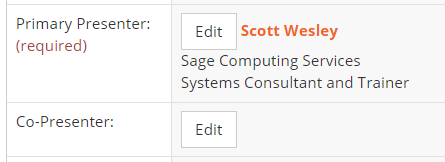
Clearly someone needs to be written as the primary presenter, but do you have a friend?

Seriously, you may have a colleague that contributed just as much to the topic, why not present with them? Well, there's probably a hoard of reasons, including the fact they may never have presented before - but if you're up for it, mentoring is rewarding for all parties. And starting to present can change your career trajectory.

Is this good or bad?

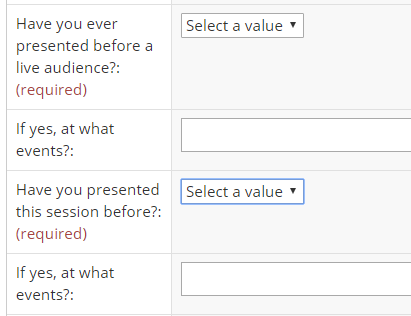
This first question about having presented to a live audience before gives the reviewers some context regarding your experience, but this year, after just over a decade of presenting, I got a different perspective on the second question.

"Over a decade" sounds a little too grandiose. I pick one, sometimes two topics a year, and present them at our local conference. Sometimes I might do one twice, perhaps in a second city, or at a local meetup. I don't get much re-use.

However, some conference regulars will use & refine the same session numerous times a year. I had the opportunity to do my APEX for Forms Developers session 3 times, and it wasn't until the third that I really felt I nailed it. I had trimmed enough chaff, reordered the odd slide, integrated feedback, and neatened the story. And this is even with practice sessions under the belt, but Martin's recent post on controlling the presentation monster was a good kick in the behind for some aspects of my preparation that has been lacking in recent years. Perhaps I've become a little complacent.

As for the "Have you presented this session before" question, initially I thought it was a virtue to consider my presentation as 'fresh' for Kscope, something other people haven't had the opportunity to see yet. Perhaps I'd forgotten, because I certainly valued doing my inaugural Kscope session in Perth first.

(There is a 90 minute option)

Session Length is typically one hour. If this seems long, don't worry - it can be filled. And as it turns out, trimming a 60 minute presentation that was already a tad long into the Australian 45 minutes took a lot of cutting. But good cutting, like cutting superfluous code.

And it reminded me how good it is to get a targeted, concise presentation topic.

I realised my second abstract could also work as a 30 minute Workshop, so I added to the review committee notes, and maybe improved my chances a notch. My fourth submission could also work as a fully fledged hands on lab, so ... why not?

There are a heap of regular speakers at these gigs, but as Opal points out, there are a good percentage of new speakers every year - even at a high demand conference like Kscope. .

And it's not just Kscope - there are a wealth of conferences around the world, ready to listen to what you have to say. Check out the call for paper schedule at Clocwise (built with love using Oracle APEX).

There are a few other questions on the form, and plenty of other considerations when it comes to submitting abstracts, but these few stood out to be and I felt compelled to share.

I'd also add that there are so many quiet achievers out there that have expert knowledge of various features, they just don't blabber on blogs about it. We've got to find those pearls.

Also consider taking part in the public voting for Kscope abstracts. It's an interesting way to get a feel for what a good and bad abstract looks like, and may inspire a new range of ideas.

So bada bing bada boom, once you have your slides nearly done - practice practice practice, and have a listen to this sound advice from Connor - it's a great help <ahem>.
  • Honesty - I've heard this from Connor for years, it's so darn true.
  • Expert - we're all subject matter experts on something.
  • Love all the things - love the topic. love being there to share.
  • Practice - matters.
I was lucky enough to have as an instrumental guide on my path to speaking. I've heard these messages in various forms over the years, and he really hits the nail on the head.
And now he's being an instrumental advocate, providing various levels of support for Oracle developers around the world - not bad for just a tech guy.

Seriously though, he will help you out, and you won't feel like you need to write a 400 slide monster.

"Connor, your deck is 90 slides."

"Yeah"

"But you've only got 5 minutes"

"Yeah"

"..."

Wednesday, 31 December 2014

Speakers looking for New Year's Resolutions?

If you're a semi-regular speaker looking for a new year's resolution, how about learning this little ditty?


I never opened the clip of Daniel Radcliffe doing the same song not long ago on Jimmy Fallen - I don't really watch his movies I skipped by, but I did get baited by something on Facebook mentioning the reporter's (Kim Powell) a capella warm-up method.

Turns out it's a 1999 rap by Blackalicious, lyrics for your practicing pleasure. I don't know if this is the original video clip, but it's a rather creative and would have been cutting edge for it's time.

Anyone up for doing this prior to Kscope15? ;p