Tuesday, 19 November 2019

APEX Low code expressions

The following where clause expression would normally return false, therefore the query would deliver no rows.
select * from dual where null != 'X'

no rows returned
A null can never equal a value, and hence cannot be determined to be disimilar to another value. False is the expected condition.

Turns out when using it as what appears to be the  declarative low code alternative, it returns true – and renders.

So if you want to display something based on a field that may have a value you don’t want, eg:


This will display the component if P10_NULL is anything but "yuck", including a null value.

In my business case, there was an occasional value of "D" that I need to hide things for.

Instead of using (slower) PL/SQL expression
nvl(:P42_CAT,'x') != 'D'

or SQL expression (anything but = D)
lnnvl(:P42_CAT='D')

As Kim suggests, our brain is seeing something SQL-ish, when really it's a low code translation that probably nails most scenarios - and maybe it would be better re-worded slightly as "not equals"

Our low code alternative is not only faster, but simpler. It turns it into just another if statement, as opposed to a snippet of PL/SQL that's interpreted on the fly, which is why dozens of global page conditions using PL/SQL expressions will slow your application.

Tom Kyte's mantra was to aim to reduce to just a single SQL statement (or no SQL at all).
Perhaps APEX developers should advocate for declarative attributes where possible, only then maybe try an expression or query.

So you want to submit a conference abstract?

It used to be our annual Perth conference that got me thinking about abstract ideas, but now it's the Kscope abstract submission deadlines that get my boat rocking.

But every day is a good day to think about the topics I'd like to might like to share with to your local community.

I've also been trying to convince a collegue to do their first presentation, and the questions in the ODTUG submission page got me thinking, so I thought I'd share some of those thoughts.

So here are some of the questions in the Kscope20 abstract submission form.


This is arguably the best conference for Oracle developers, and we only constitute a portion of delegates! I selected the APEX Track.

But the Session Title is obsiouly a good place to start. It needs to be catchy, concise, yet inform the reader as to what to expect - even without reading the abstract itself.
What session headline would grab you?
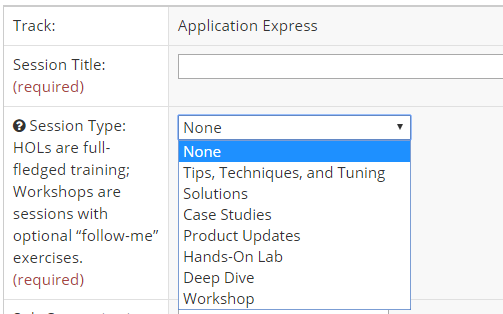
I like the descriptive distinction between HOLs and Workshops

The title can lead to focussing your content, which is necessary. Scope creep is something that's been on my back these last few years, and a good title can nail a good portion of this down. The Perth conference form asked for 3 objectives, which is an awesome way to focus scope. (I don't think this should be confused with Martin's concept of the evil threes)

Searching for my first presentation topic took some time. Something I felt experienced enough to talk about, something that felt relevant, useful to others. Now I have such a large list of ideas splattered on a Trello board, if anyone is thinking about doing their first presentation but can't think of a topic, I'm sure we can eke one out, even without necessarily knowing your skillset.

The Session Type can also be a prompt for ideas. Presentations can often be categorised by style and format, something Penny & I explored one year in a session of our own.

Maybe you have a collection of related tips, or you have a case-study to share where successfully utilised a nifty feature? Or some feature people haven't been talking about enough?

There is also a Sub-categorisation that varies by track, and helps align the content to relevant product sub-sets. There's an impressive amount of detail on these here.

Analytics / APEX / Database / Modern App Dev / ...

Naturally, at some point we need to write the abstract. The few paragraphs that inform the delegate about the story you're delivering. I've been stewing on mine for a while. Write a draft one night, review it another. What's being taught? Is it new? Is it compelling?

But the abstract is also helping define your scope. A simple aim, an interesting insight, and an awesome outcome.
What were your three main objectives? That's 10+10+10 minutes, with a few on each side - bang, you've got your talk. Now to divide & conquer. But remember, 10 minutes can disappear real fast.

Make sure there's no boasting or selling going on, that can be left for the notes for the review committee. I like this distinction. The Session Summary educates the delegates what you're talking about, the Notes educate the committee as to why you're gone with this topic, any maybe do some selling (of yourself) there. I also included my 3 session objectives, for a concise perspective.
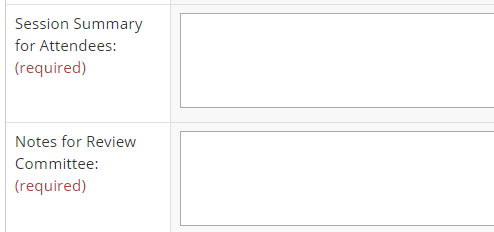
For everyone, then for the selection committee

And don't forget to check grammar and spelling!
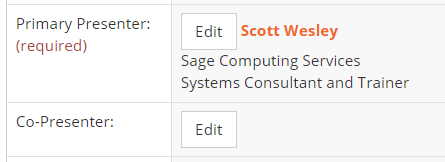
Who's on first? What's on second?
Clearly someone needs to be written as the primary presenter, but do you have a friend?

Seriously, you may have a colleague that contributed just as much to the topic, why not present with them? Well, there's probably a hoard of reasons, including the fact they may never have presented before - but if you're up for it, mentoring is rewarding for all parties. And starting to present can change your career trajectory.
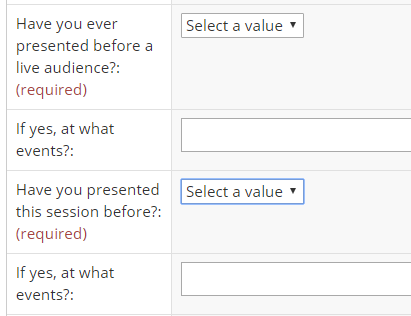
Is this good or bad?

This first question about having presented to a live audience before gives the reviewers some context regarding your experience, but this year, after just over a decade of presenting, I got a different perspective on the second question.

"Over a decade" sounds a little too grandiose. I pick one, sometimes two topics a year, and present them at our local conference. Sometimes I might do one twice, perhaps in a second city, or at a local meetup. I don't get much re-use.

However, some conference regulars will use & refine the same session numerous times a year. I had the opportunity to do my APEX for Forms Developers session 3 times, and it wasn't until the third that I really felt I nailed it. I had trimmed enough chaff, reordered the odd slide, integrated feedback, and neatened the story. And this is even with practice sessions under the belt, but Martin's recent post on controlling the presentation monster was a good kick in the behind for some aspects of my preparation that has been lacking in recent years. Perhaps I've become a little complacent.

As for the "Have you presented this session before" question, initially I thought it was a virtue to consider my presentation as 'fresh' for Kscope, something other people haven't had the opportunity to see yet. Perhaps I'd forgotten, because I certainly valued doing my inaugural Kscope session in Perth first.

(There is a 90 minute option)

Session Length is typically one hour. If this seems long, don't worry - it can be filled. And as it turns out, trimming a 60 minute presentation that was already a tad long into the Australian 45 minutes took a lot of cutting. But good cutting, like cutting superfluous code.

And it reminded me how good it is to get a targeted, concise presentation topic.

I realised my second abstract could also work as a 30 minute Workshop, so I added to the review committee notes, and maybe improved my chances a notch. My fourth submission could also work as a fully fledged hands on lab, so ... why not?

There are a heap of regular speakers at these gigs, but as Opal points out, there are a good percentage of new speakers every year - even at a high demand conference like Kscope. .

And it's not just Kscope - there are a wealth of conferences around the world, ready to listen to what you have to say. Check out the call for paper schedule at Clocwise (built with love using Oracle APEX).

There are a few other questions on the form, and plenty of other considerations when it comes to submitting abstracts, but these few stood out to be and I felt compelled to share.

I'd also add that there are so many quiet achievers out there that have expert knowledge of various features, they just don't blabber on blogs about it. We've got to find those pearls.

Also consider taking part in the public voting for Kscope abstracts. It's an interesting way to get a feel for what a good and bad abstract looks like, and may inspire a new range of ideas.

So bada bing bada boom, once you have your slides nearly done - practice practice practice, and have a listen to this sound advice from Connor - it's a great help <ahem>.
  • Honesty - I've heard this from Connor for years, it's so darn true.
  • Expert - we're all subject matter experts on something.
  • Love all the things - love the topic. love being there to share.
  • Practice - matters.
I was lucky enough to have as an instrumental guide on my path to speaking. I've heard these messages in various forms over the years, and he really hits the nail on the head.
And now he's being an instrumental advocate, providing various levels of support for Oracle developers around the world - not bad for just a tech guy.

Seriously though, he will help you out, and you won't feel like you need to write a 400 slide monster.

"Connor, your deck is 90 slides."

"Yeah"

"But you've only got 5 minutes"

"Yeah"

"..."

Tuesday, 12 November 2019

Things I learned at a user group event

Yesterday I attended a friendly, informative workshop by Shakeeb Rahman and Christina Cho, members of the Oracle APEX product team.

Reflecting on the worthiness of attending such an event, I thought I'd list out all the things I learned & observed.

  1. Everyone learns.
    It was observed that 'gurus' such as Trent, Lino, and myself were there, and maybe this might influence the level of detail content delivered. Sure, I like the details, and a particular pace, but I'm there to learn a bunch of things as much as the next person. My REST skills need a lot of work, it's always great to get a demonstration of features found in the new version. The APEX feature set has grown so much, I'm struggling to stay across it all. I attend these sessions because I know the value I can get out of them.
  2. Watching Shakeeb build.
    The last session involved Shakeeb using Quick SQL to build and populate data in seconds, then transforming the default output to look like a feed like Twitter. He did it in about 30 minutes, only using CSS once, maybe because his perfectionism was showing ;p
    As awesome as it was seeing the showcase that is APEX in action with declarative/low code techniques, I also get a lot out of seeing Shakeeb's thought processes, and how he moves about the IDE.
  3. REST Services.
    One of my attractions to this event was the workshop on REST services. I understand the mechanics, but have not had enough practice using the declarative features. Having a hands on lab where I not only receive instructions in person, but get to ask Christina deeper questions as I explore the workshop. This was invaluable to understanding the feature integration. I have a few posts in mind to help bake it in.
  4. Data is important.
    Our client would have appreciated Shakeeb's opening remarks. While we all know data is important, it can't be iterated enough to those decision makers that may not have enough understanding of the value of databases.
  5. APEX Longevity.
    I knew this one already, but I like the fact this slide has made it into Shakeeb's commentary. APEX has seen so many JavaScript frameworks come and go, with little resistance between versions. I think this is rarely seen in the programming world.
  6. Faceted search looks amazing.
    This will a boon for creating interactive applications that people are used to even quicker.
    I'm interested to see how this responds to more complicated queries, but there seems to be options for everything. I look forward to this feature, as we already build similar constructs already.
  7. The native Popup LOV looks even more suburb.
    They really have learnt from the two solid plugins that came before them. Based on the attributes I saw demonstrated, this has everything we need, and everything we didn't realise we should have. And this is iteration one. Awesome.
  8. I don't need to rely on a CSS overlay to remove toolips
  9. We can hide empty display positions in the layout editor
  10. The undo/redo tooltip was restored to native HTML in 19.x, different to the rest (thanks to sharing the love on Twitter).
  11. I was reminded of an auto-height template option for inline modals.
  12. There is a template option for 'icon and text' button templates to hide text for mobile devices.
  13. A component setting was introduced to transform application Switch items into the pill format - yet another application level optional upgrade between versions.
  14. Syntax in the code editor for SQL Workshop and Quick SQL is now highlighted. I think this improves readability and is a form of inline validation for your syntax.
  15. SQL Workshop Object Browser has a few more tables, including suggested sample queries for the tables - the same sort of group by queries that I use to help analyse what's going on in a table. The same queries that utilised in the faceted search analysis. Code & data re-use right there.
  16. We can now REST enable tables right from the SQL Workshop, with the flick of a switch.
  17. I was reminded Postman was a nifty tool for REST development.
  18. We can jump to the create application wizard from a table. I can't remember how, nor find the option, but I can't remember everything from the day... I make these notes to help, but hey.
  19. Data dictionary cache is a thing. Again, I can't recall exactly how it worked, but I've made a note to investigate later as I explore the faceted search facilities.
  20. The spotlight search has been expanded, and there are other nifty shortcuts that already exist. I use some already, but I now know to keep aware.
  21. Paged designer multi edit - I am looking forward to these improvements, which include the ability to change template options for multiple components at once - hallelujah! But I wasn't aware that some attributes were previously hidden during multi-edit mode, so this has eased.
  22. The ability to change the application logo has received all the declarative nick-knacks we needed.
  23. This application logo is separate from the one defined in the login screen, which as also received a wodge of declarative low code improvements.
  24. There is now a pre-built template style for dark mode. While I was aware of this, it's always beneficially for me to see Shakeeb operate the theme roller, since I don't use it enough.
  25. Theme roller facilities are more refined
  26. The Content Row report template - I'm looking forward to this so much I've retrofitted the template into 18.2, for demonstration
  27. All the interactive report dialogs have been re-written, with a fresh look.
  28. Menus UI can be tweaked with a 'callout' nature. We'll see how that's adopted in general...
  29. Inline regions have been given some upgrades. I've been playing with a page to experiment with these recently (post coming), so this event gave me the opportunity to ask some specific questions.
  30. Inline popups can be located near the invoking component, documented in the UT application.
  31. Lino showed me how to define inline region size with classes, instead of jQuery (to be included in post).
  32. Lino is approachable regarding my growing list of AOP questions.
  33. And as the session was beginning, I felt a little inspiration to solve a regular expression problem I was facing last week. Some interesting performance observations noted as I experimented further today, and had a regexp expert to review my work. (post coming)
  34. Christina is another solid member of the APEX family. I've had the pleasure of conversing with quite a few members of the team now, and they're a great bunch.
  35. Juniper berries are used to make gin - it was the drink'n'learn on the beer cap, in our afternoon wind-down.
And I reckon there might be a few I left off. The Q & A included some conjecture about 20.1.


Brisbane & Sydney also get the pleasure enlightment musings of Connor.

Not bad for a user group event, eh? 

It's a shame some people struggle to get support from their employers to attend such events, and more of a shame we don't see more students getting engaged. How do we reach them - the next generation?

I'm glad they came, and I'm glad I went. There are some growing APEX markets around here, and some with lulls. If we don't get the visits, the next round of students will not eventuate. It's not just the people who attend the workshops, but the flow on effect from those individuals who report back and share information with other team members. It's certainly what I did with my colleagues. Who knows who's ears could be listening in on that positive feedback.

Monday, 4 November 2019

Do you want to learn about database technology?

Do you live close enough to Melbourne, Brisbane, Sydney, Seoul, or Tokyo to attend a software development roadshow for a day in November?

Are you interested in how easy it is to build data driven web based applications?
Perhaps you're a student of the programming world?

Your local user group is hosting some visitors from the US that I think are worth listening & engaging with, in person. And if you're not a member of the user group, it's only $50 for the day.

https://blogs.oracle.com/apex/oracle-apex-apac-tour-2019

50 bucks.

For a day of learning, engagement, and networking with industry peers.

I can't emphasise that networking element enough, particularly for those still formulating their career goals & focus.

It's been a while since I was a graduate, but I relished the information I gathered at the local user group events. I was recently privvy to witnessing a member of the next generation of technology professional help shape her career at our conference.

It's worth investing a day in yourself, to help inspire your work tomorrow, to help nurture your love for your job. Whatever the stage of your career.

Warning, tangent ahead.
While I now find myself a regular speaker at such events, I also still value attending them, even with the advent of regular, engaging, recorded online technology seminars with experts and those that build the product.

That photo? That's Oracle product manager David Peake helping out. That's what these communities do - get you within one degree of separation of the product itself.

I can't keep up with all the new gadgets being made available in my development tool of choice.
I certainly need more practice with REST technology, and a hands-on-lab with the development team would really help.
We're also about to level up with our version, so another revision of all the new kit will be super handy.

And Shakeeb is a really slick presenter. It's not just the technology I learn about when watching the sessions by Shakeeb, or Connor & Steven, or many other seasoned (and some new) presenters.
And I'd like to meet Christina, add to the list of the APEX team I've met in person.

Seeing them in person is something else. Nothing beats having a face-to-face conversation with someone about ... anything really. And to then establish that rapport, that human-to-human contact with other people. It can remind us to be humble. A reminder that we all make mistakes; we all continue to learn; and most importantly - none of us know everything.

We see regular personalities on the speaking circuit, or those bloggers out there that pump out their experiences online. These are only a small percentage of all the developers out there, working hard, empowered by education, utilising online resources, leveraging off forum conversations. Sometimes it feels like they seem to know so many things about the product, but really, most of them are just making notes, and thankfully publishing them in a manner for us all to benefit. Don't let the imposter syndrome get you down.

And let's not forget the friendships that are forged at such events. Yes, you're allowed to have friendships at work, it helps keeps smiles on our faces when times are tough.

So. 50 bucks, unless you're already a member - then it's free!

Learn about how to get your FREE Oracle instance.
Learn how to use a low code development tool to build apps.
Learn how to source data from web services.
Learn what's in the latest version of the product.
Have an engaging session where you have the platform to ask anything.
And do it - if you have the chance to ask a burning question, odds are there is at least another person nearby with the same question.

Thank you, Oracle for your growing engagement with the community, and thank you to our local user groups for helping facilitate these visits, and most importantly, thank you to the community - actively producing content, and those who drive up the SEO by quietly read all the content.

Thursday, 10 October 2019

OGB Appreciation Day : Oracle Reports Server Queue Monitoring

Today is a day to celebrate what's great about our Oracle 'Groundbreakers' community. Our favourite stuff, what we're learning, horror stories, or just a little thanks.

I missed the second year because of holiday prep - so I decided to beat that this year by writing this the day I saw Tim's call-out on Twitter. Especially since I'm flying out to Melbourne for AUSOUG Connect, plus a little R&R.

I knew I had a few worthy ideas queued up, but I pondered for a moment on the most recent idea I noted.

So this year I'm going a little meta, or recursive, if you will - I'm acknowledging one of the posts from the original year. Oracle Reports Server Job Queue Monitoring. Thanks, Garth.

I wouldn't call this a duplicate post, rather a re-inforcement of this blog-fest, and I add some APEX spice.

I'm not entirely sure how I came across Garth's post, but I'm certain if it wasn't there, I wouldn't have realised I could transform that trusty but transient report queue servlet into table data in 3 easy steps.

A reliable page, but a little dated

And once they're in the database, we can APEX the shit out of it.

Now we can fold this data into awesomness

As Garth details in a second post, and Doc ID 2098657.1, it's a relatively simple matter of
  1. DCL to define table owner
  2. DDL to define some objects
  3. Minor Report Server configuration
Now we can query rw_server_queue to see how many of which reports were executed each day by who.

Why would we want to do this? It's 2019, why am I blogging about an Oracle Reports feature?
So we can analyse reports usage in the legacy system before migrating to AOP, of course!

You can also find the relevant SQL here, to make it easier for some of us to find & utilise.

So that's now two #ThanksOGB references in one, illustrating how worthy participation in such an even can be.

Past posts


2016 OTN - Dynamic Actions
2017 ODC - (dog at my homework)
2018 ODC - APEX Workspace Activity Logs
2019 OGB - Oracle Reports Server Queue Monitoring
2020 OGB - (quite possibly something that also shares a precursor to Oracle Reports)

Monday, 7 October 2019

So you want to learn Oracle APEX?

Are you involved with Oracle? Perhaps your a DBA, or a PL/SQL data master, possibly know a bit about Oracle Forms, and you want to learn what all the fuss is about regarding Oracle Application Express (APEX)?

My best elevator description? It's a low code development tool that lives in the browser. Yep, the IDE is a web page that allows you to add SQL, PL/SQL, modify a few attributes - and you've got a data driven web based application that runs on any device. Easy for any Oracle technologist to learn.

This is not a new tool, it's been around since 2004, conceptually even before then.
We've built applications that have lasted for years with minimal inteference. They've outlasted other popular frameworks, and they're still within touch of the present. Still doing the basics of the web, in a clever, interactive way.

AskTom has been using this technology before it was called HTML DB.

It's also being mentioned out there, in the world beyond our bubble.

And it's hitting the news for the right reasons - helping natural disasters.

And helping people take action regarding climate change.

This all started from Kscope19, and it appears momentum continues to grow.

So do you want to board this hardy vessel?
The community is strong & passionate.

Use this as your starting resource
http://apex.oracle.com/shortcuts

Sign up for a (no obligation) workspace on apex.oracle.com.

Your web page is your IDE now. Lucky, the modern browser is a nifty place to be.

That's APEX. You paste SQL queries / PL/SQL API calls in a box, change some attributes, and there you go. Simples. You have data driven web applications, ready to use on any device.

As for skillset, I have a few JavaScript one-liners I use regularly, sometimes I embed some simple HTML, and I have a mechanical understanding of CSS - which is just queries against your page content.
You know how a web page works? You know Oracle stuff (SQL, stored procedures)? You'll be fine.

If you have Oracle Forms experience, maybe check this out.

Empty the cup.

Try the documented tutorial
Install some packaged applications, check out how certain features tick.

Looking for your source code? It is just meta-data in some tables, check out
select * from apex_dictionary;
and
select * from apex_applications;
See how far the rabbit hole goes.
SQL developer has some dedicated tools for the job.

Try the Maze Runner presentation by Jorge & Jackie, to find your feet.
Want to know what components are available? go to apex.oracle.com/ut
Charts are particularly awesome: apex.oracle.com/charts
Got a question? Try the forums.
Like a conversation? Try Slack
Happy to chip in for some help? askMax.
Want a place to visit, learn & keep in touch for 5 minutes every day? Try apex.world
They have a page titled "How to start as a developer".
Also check out the plug-ins page, to fill any gaps in the builder.
Steady blog stream available here.
Do you like to listen? There are currently two active podcasts.
If you like books, I particularly recommend the collaborative efforts.
If you like videos, I have a series, and plan another. Caleb Curry also has our back.

Need to load spreadsheet data? This. And this.
Want to talk to web services? Find Carsten.
Do you really need to produce a PDF? AOP (APEX Office Print) is your best option.
Moet dingen vertalen? Translate APEX
Want to get a little funky with your page interactions? Check out Maxime's award winning demo app.
I recommend you learn not what you can do for Dynamic Actions, but what dynamic actions can do for you.

Want a second opinion on this list? Try this Github, because it adapts.

Want to get serious about delivering your app? Get a piece of an 'always free' tier, and check out Dimitri's guide. Or you could build you own stack with the free Oracle XE.

Note, the preferred pronounciation is a-pex, not app-ex. I blame my accent for any mispronounciations ;p This guy knows.

It's also "APEX", not "Apex". Possibly as not to be confused with SaleForce 'Apex', which if I recall is something pretending to be Java. "ApEx" is as painful as camelCase.

You generally need to prefix any searches with "oracle apex"

Or just ask a question on Twitter with the hashtag #orclapex. Someone is bound to point you in the right direction.

Note that even those without a Twitter account can browser activity in this tag. I recommend getting involved, it's an active zone for the Oracle team.
You might see it as #orclAPEX, which not only helps get it right, but helps #a11y

Let me know if you think something else belongs here.

#letswreckthistogether

Thursday, 26 September 2019

Thursday Thought: Look all around you

A current pleasure of mine after getting home while the sun is still pleasant is to take my (currently) nine eighteen month 5 year old for a stroll in her pram. It's been a while since I drafted this, time to tidy up the backlog...

We were lucky enough to live opposite some bushland, big enough where you can do a 30 minute loop and enjoy a mostly native tree/scrub area. There are obvious trails that are no problem for a pram, but still give plenty of bumps for the young one to practice her vocals.

Through the right combination of events - since coincidence has such amazing potential, I decided to walk down a dead end trail I rarely walk through and enjoyed it so much I had to share.

We recently had some short but hard rain - a nearby corridor of suburbia experienced some freakish hail. This made the ground a little firmer, and soon after some maintenance vehicles travelled this particular trail. That left it ripe to preserve footprints in such a way that I'm sure left a tale that I'm far from being able to fully interpret.

It made me think back to our ancestors and their reliance on the ability to interpret such information in a way to live longer. To know how long since predators passed by, and how long ago; follow prey in the right direction; recognise footsteps from strangers.

All I could do was recognise big dogs, small dogs, kangaroos - though it's been a while since I've seen them. I saw smaller prints that could be rabbits, cats, or both. A few bike tracks, human shoe prints over the tyre tracks - all in a variety of orders.

The dog tracks were erratic, kangaroos had an obvious direction - and where very far apart! I also considered what I couldn't see - any snake trails. I know plenty of other reptiles live in there, there's no reason to think I couldn't find any dugites or maybe even tiger snakes if I know where to look.

Earlier today as I left work the first thing I saw in the sky was a contrail that split the sky. The tropospheric winds must have been relatively still because the start of the trail was still quite defined. I enjoyed a little giggle at the chemtrail conspiracy theorists that think it must be poisoning day - they don't happen very often in Perth thanks to local conditions.

As I arrived home the perspective had changed, and by the time I was on my walk the vapour dissipated into such an amazing pattern, covering the setting sun.

I thought it best to try describe the nature I enjoyed this afternoon rather than post a few cool pictures. Partially because I thought my writing skills might benefit, and more profoundly - I think contemporary society needs to remember to take time out from technology and let the brain do it's work behind the scenes. Process the information of the day, enjoy the current surroundings, think about the most bizarre succession of thoughts that take you some place far from the present - or one of the favourite things I heard a former martial arts teacher say: find your thoughts, then lose them.

If you enjoy occasional ramblings like this that might provoke a few related thoughts in your own noggin, you might also enjoy Steven Feuerstein's personal blog -> feuerthoughts.blogspot.com, though he seems to have another major project on the go since I drafted this post.
You can also try using the Thursday Thought, Science and/or the Friday Fun labels on my blog.